Tax Hotline
January 15, 2009
Deputation of supervisory personnel not to create PE in India
Contrary to what one may summarily infer from the Supreme Court’s decision in Morgan Stanley1, deputation of employees may not always give rise to a permanent establishment (“PE”) in India. This has been upheld in the recent decision of the Income Tax Appellate Tribunal2 which clearly brings out the dichotomy between agreements for the supply of personnel and those for the supply of services.
The assessee (taxpayer), a Dutch company was awarded a contract to construct a refinery in India on a turnkey basis. The assessee set up a project office in India for the purposes of execution of the project. It contracted with its Malaysian subsidiary to provide technical personnel who would provide services in connection with the Indian project. The Malaysian company was engaged in the business of hiring and supplying personnel with the required expertise. The personnel, though employed by the Malaysian company, were under the direct control and supervision of the assessee.
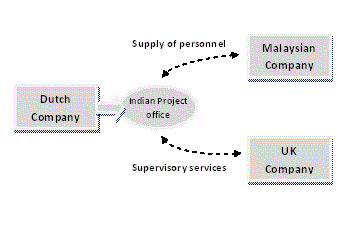
The tax authorities disallowed deduction of the payments made to the Malaysian company under Section 40(a)(i) of the Income Tax Act, 1961 on the grounds that the assessee had not withheld tax payable thereupon. It was contended that the Malaysian company, by virtue of rendering supervisory activities in India (through its employees) for a period exceeding six months, had a PE exposure in India. It may be noted that while the India-Malaysia tax treaty does not have a service PE clause, a PE may be constituted under Article 5(4) of the treaty through the rendering of supervisory services in connection with construction activity in India.
Presuming that the said payments were in the nature of business profits and not fees for technical services under the India-Malaysia tax treaty, the Tribunal accepted the contention that the Malaysian company was only required to supply personnel and not to provide any service in India. The mere deputation of personnel to the assessee would not imply that the Malaysian company carried on any business activity in India. The role of the Malaysian company ended with the supply of personnel who subsequently functioned under the direction, supervision and control of the assessee.
The Tribunal also relied upon an earlier advance ruling3 dealing with similar facts where it was held that the mere recruitment and supply of labor from abroad would not give rise to a PE in India.
Since the Malaysian company did not carry out any business in India, the Tribunal held that there was no PE exposure and the payments received by it for the supply of personnel would not be taxable in India.
The Tribunal also reversed other disallowances made by the tax authorities in respect of salary payments to engineers functioning from the head office, and fees paid to another Dutch company for certain technical services. With respect to payments made to a UK company for providing supervisory services in relation to the construction of the refinery, the Tribunal made an interesting observation that such services cannot be construed as being rendered in connection with the production of mineral oil which would have otherwise given rise to PE exposure under the India-UK tax treaty.
ANALYSIS
The Tribunal has appreciated the fact that all cases of deputation may not create a PE in India. This basic principle of PE jurisprudence had become slightly blurred after the Morgan Stanley decision which held that the secondment of employees by a non-resident would give rise to a service PE in India. This judgment brings out an important distinction between the service of providing employees and rendering services through employees which is a fundamental consideration while determining both the characterization of income (whether fees for technical services or business income) as well as the degree of PE exposure.
- Mahesh Kumar & Parul Jain
You can direct your queries or comments to the authors
1 DIT v. Morgan Stanley, 292 ITR 416 (SC)
2 DCIT v. M/s Stock Engineer & Contractors BV, 2009-TIOL-30-ITAT-MUM
3 Tekniskil (Sendirian) Berhard v. CIT, 222 ITR 551
Disclaimer
The contents of this hotline should
not be construed as legal opinion. View detailed disclaimer.
This hotline does not constitute a
legal opinion and may contain information generated
using various artificial intelligence (AI) tools or
assistants, including but not limited to our in-house
tool,
NaiDA. We strive to ensure the highest quality and
accuracy of our content and services. Nishith Desai
Associates is committed to the responsible use of AI
tools, maintaining client confidentiality, and adhering
to strict data protection policies to safeguard your
information.
This hotline provides general information
existing at the time of preparation. The Hotline is
intended as a news update and Nishith Desai Associates
neither assumes nor accepts any responsibility for any
loss arising to any person acting or refraining from
acting as a result of any material contained in this
Hotline. It is recommended that professional advice
be taken based on the specific facts and circumstances.
This hotline does not substitute the need to refer to
the original pronouncements.
This is not a spam email. You have
received this email because you have either requested
for it or someone must have suggested your name. Since
India has no anti-spamming law, we refer to the US directive,
which states that a email cannot be considered spam
if it contains the sender's contact information, which
this email does. In case this email doesn't concern
you, please
unsubscribe from mailing list.
|